How to turn stressful communication into content
Anatomy of “We are not arguing”
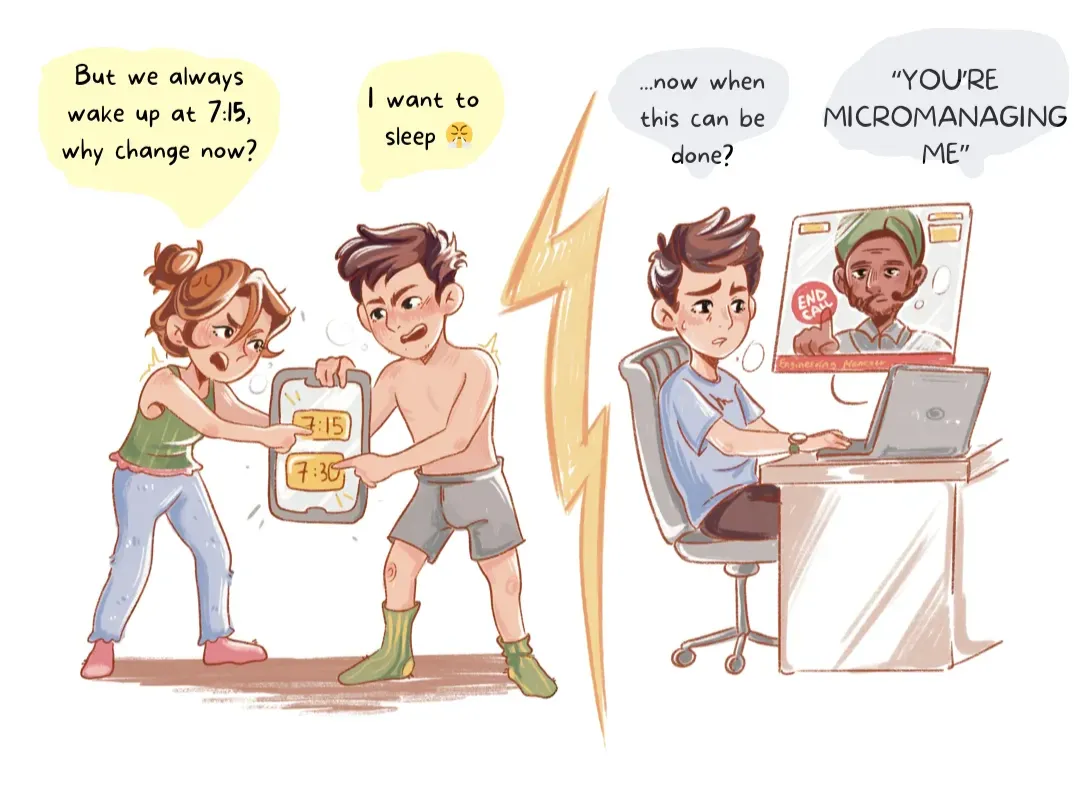
Have you ever fought with your girlfriend/boyfriend over an alarm: 7:15 or 7:30? Or you're on a call with an engineering manager, asking about deadlines, and the response is "you're micromanaging me." You go all enlightened: "let's take a pause, take a breath, and discuss this"… and the call ends. And you're left without a team, without context, and with a feeling that this is going to be fun (not). My therapist and I dug into this today, and I decided to share.
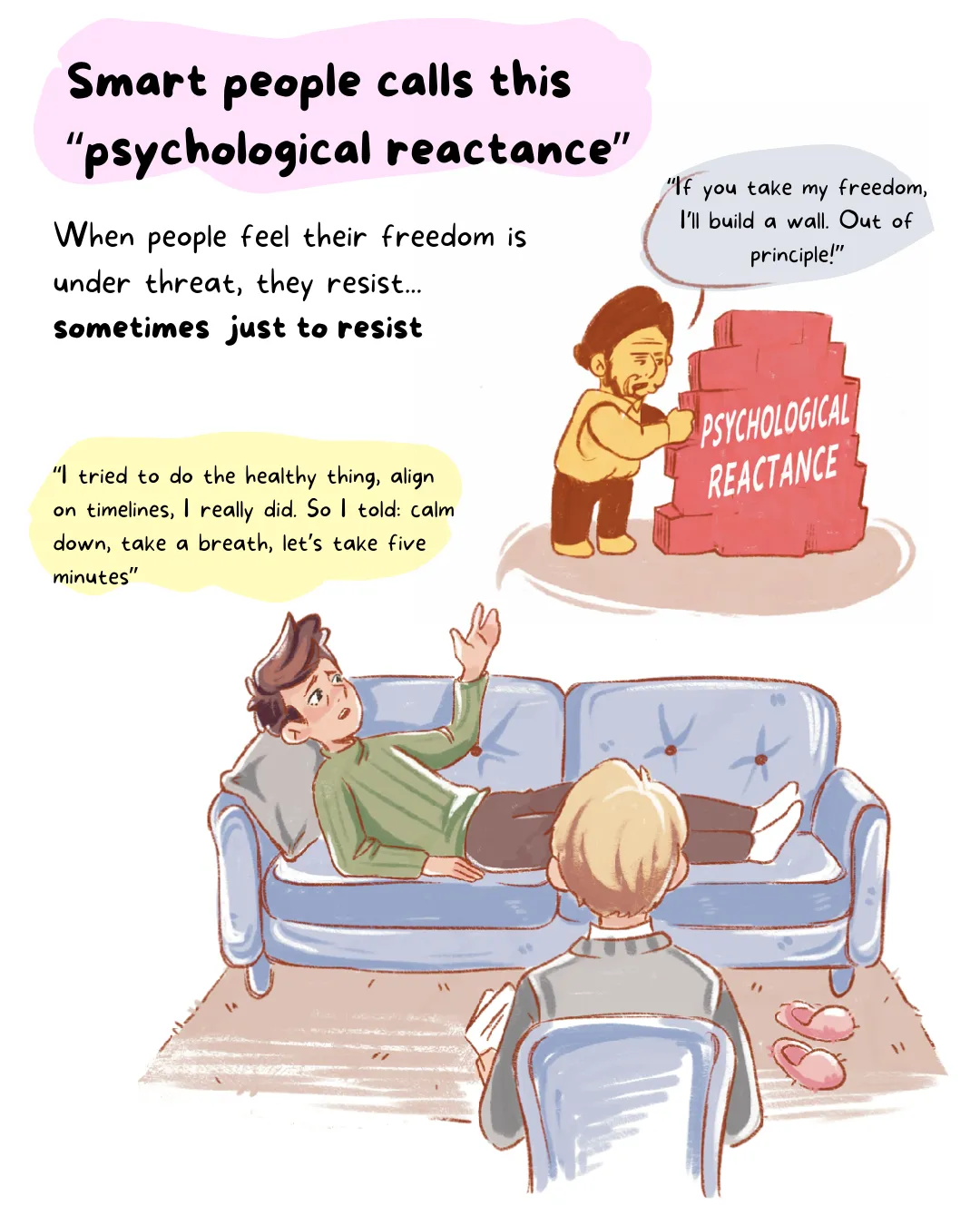
To start, this isn't "just personality" and it's not "everyone around is too sensitive, but you know better." In psychology, there's a concept of reactance: when a person feels they're being pressured or their freedom of choice is being taken away, they start resisting, sometimes purely out of principle. This is well described in the overview on psychological reactance.
And here's where I have a clear cognitive trap: I seemingly want a discussion, but suddenly I slide into polemics. Discussion is "we're searching for a solution together." Polemics is "I'm going to prove I'm right, and you'll agree with me." By the way, even the brain often works in conversation with itself not as "searching for truth," but as "a machine for winning arguments." There's a very good article by Mercier and Sperber on the argumentative theory of reasoning — the idea is that reasoning evolved for arguments and persuasion, not for calm collaborative truth-seeking. In short, the problem is that even when I think I'm searching for truth, I often slide into war with another point of view, and this is encoded in our DNA by evolution. Psychologists call this "Naïve realism". We genuinely believe we see the world objectively, and anyone who disagrees is either an idiot or biased. And the more we push with facts, the worse it gets.
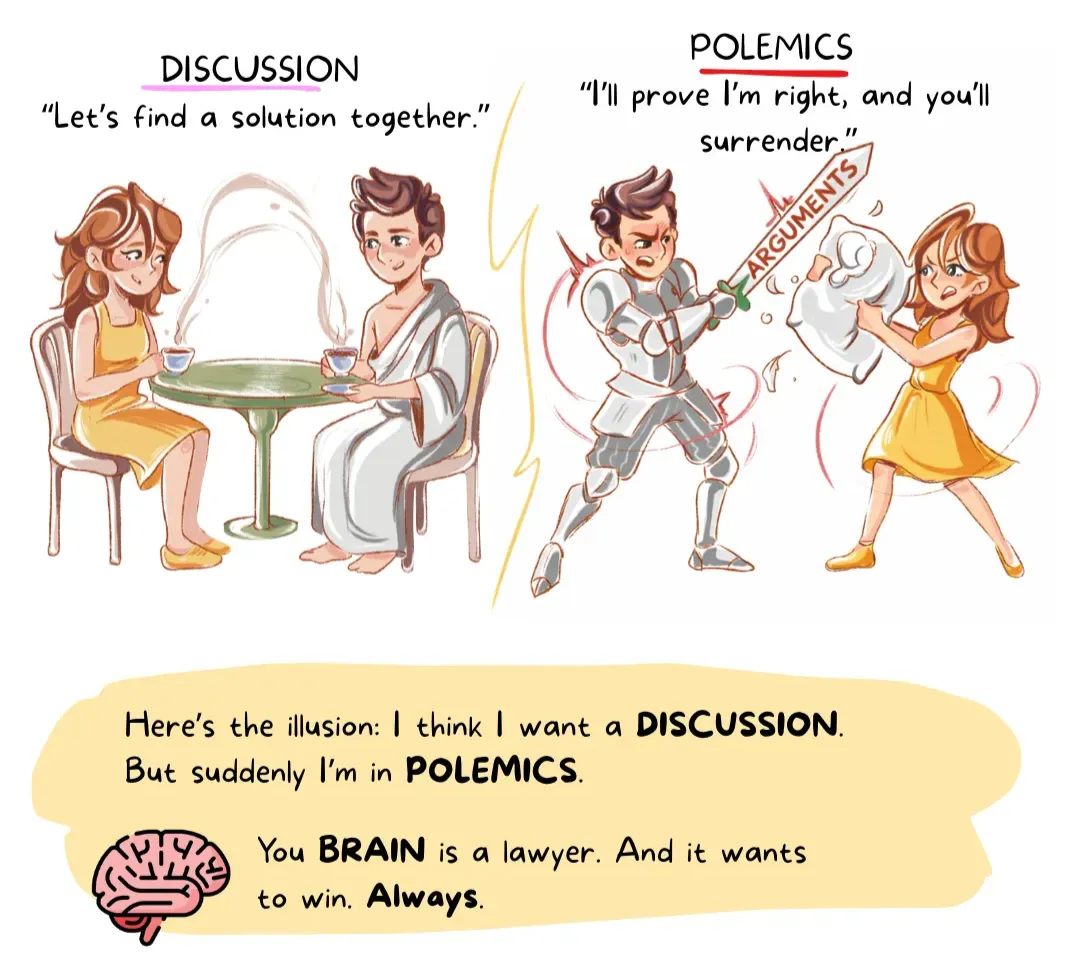
Bottom line: in conflict, I switch too quickly into "prove/push through" mode, while at that same moment the other person's reactance kicks in: feeling of pressure → triggers resistance. And then the brain adds fuel to the fire with "naïve realism": I feel like I'm objective and just want to figure things out, while the other person is "being stubborn/getting offended/being dumb." As a result, instead of discussion, you get polemics: even if I win the arguments, I lose the connection, trust, and the conversation itself.
What to do about it?
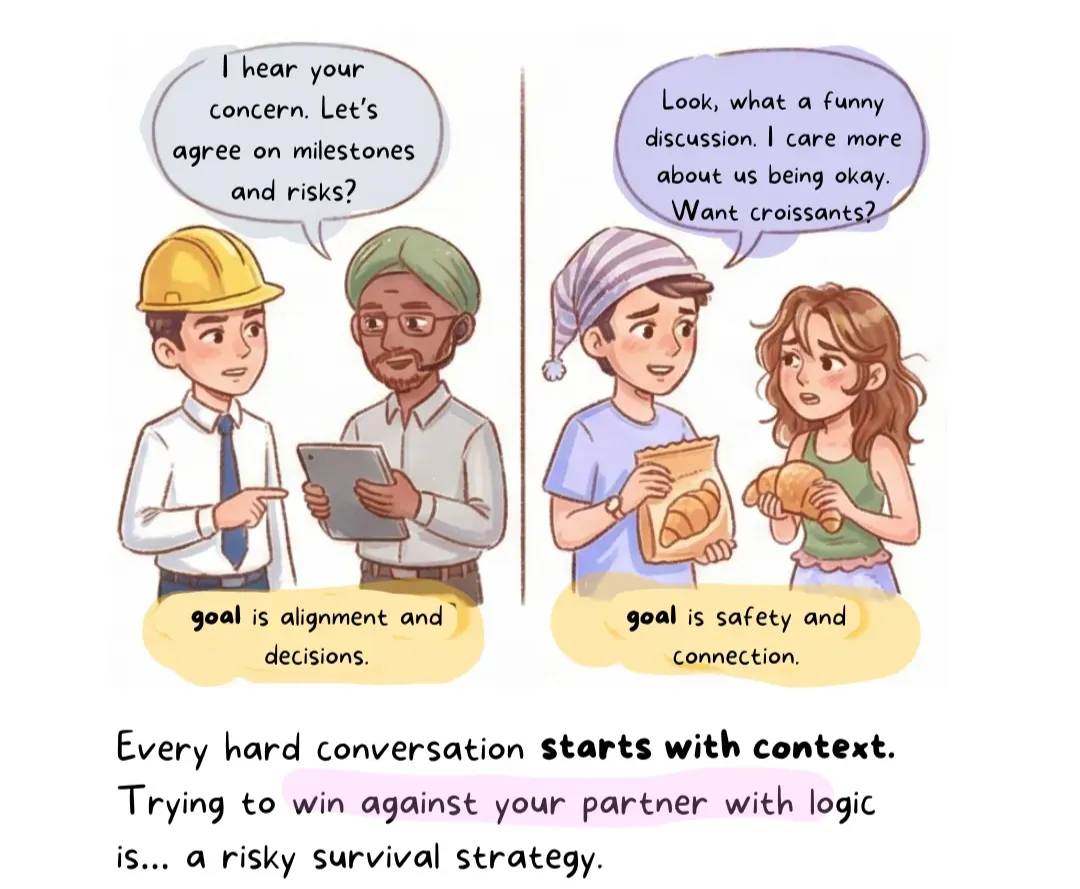
First, it's important to separate contexts: loved ones vs colleagues. The mechanisms are similar (resistance, "I'm right"), but the goals are different: at work — to agree on a plan and solution; in personal life — to preserve connection and safety.
- At work: "I hear that this sounds like micromanagement. It's important for me to reduce uncertainty about deadlines — let's establish 2–3 milestones and risks."
- At home: "Sorry I dug in, I see this upset you. It's more important to me that we're okay — let's get up whenever and go get a croissant."
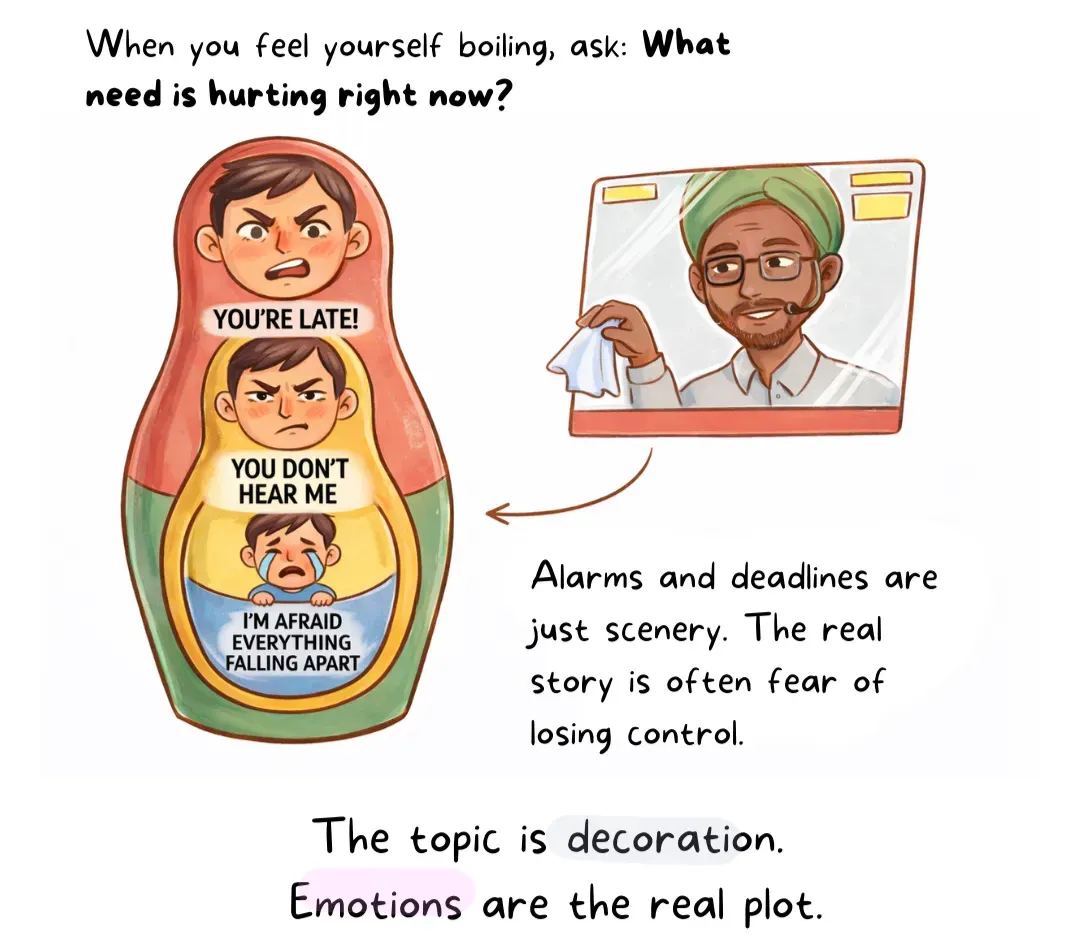
Second, once context is chosen, you can apply this frame: when I'm "boiling over," it's useful to ask myself: "What need of mine isn't being met right now?" Because often I'm not arguing about the alarm or deadlines, but about "I'm not being heard," "I'm not being understood," "everything will fall apart if I don't push through." And at that moment, the topic of conversation is a facade, decoration (fairy dust), while the real plot becomes escalating resistance (mine and the other person's). What we do: first reduce resistance, then search for truth. This is, by the way, almost canon in motivational interviewing: an empathic style and "not pushing" usually works better than confrontation, because pressure only strengthens resistance. And in relationships, Gottman has similar logic: "repair attempts" — any small de-escalation attempts (humor, "I hear you," acknowledging your part) — help not to win the argument, but to preserve connection so that conversation becomes possible at all (article).
Third, prepare the foundation in advance. I noticed that it's easiest for me to fix communication not during the fire, but after. So here's what I do: first a run/walk, so the brain dumps the pile of thoughts and the anger goes into my legs. Then I immediately record audio in Telegram or a video message for 1–3 minutes with some ideas or problems (what triggered me, what need was hurting, where I slid into polemics, what phrase I could have said differently). And only then — a short note in my blog: not "advice to the world," but an honest breakdown of how I once again tried to defeat a person instead of solving a problem. Why this helps me: I'm training clarity of communication (which reduces "I'm not being understood"), I collect phrases in advance that trigger resistance and learn to reduce my reaction to them.
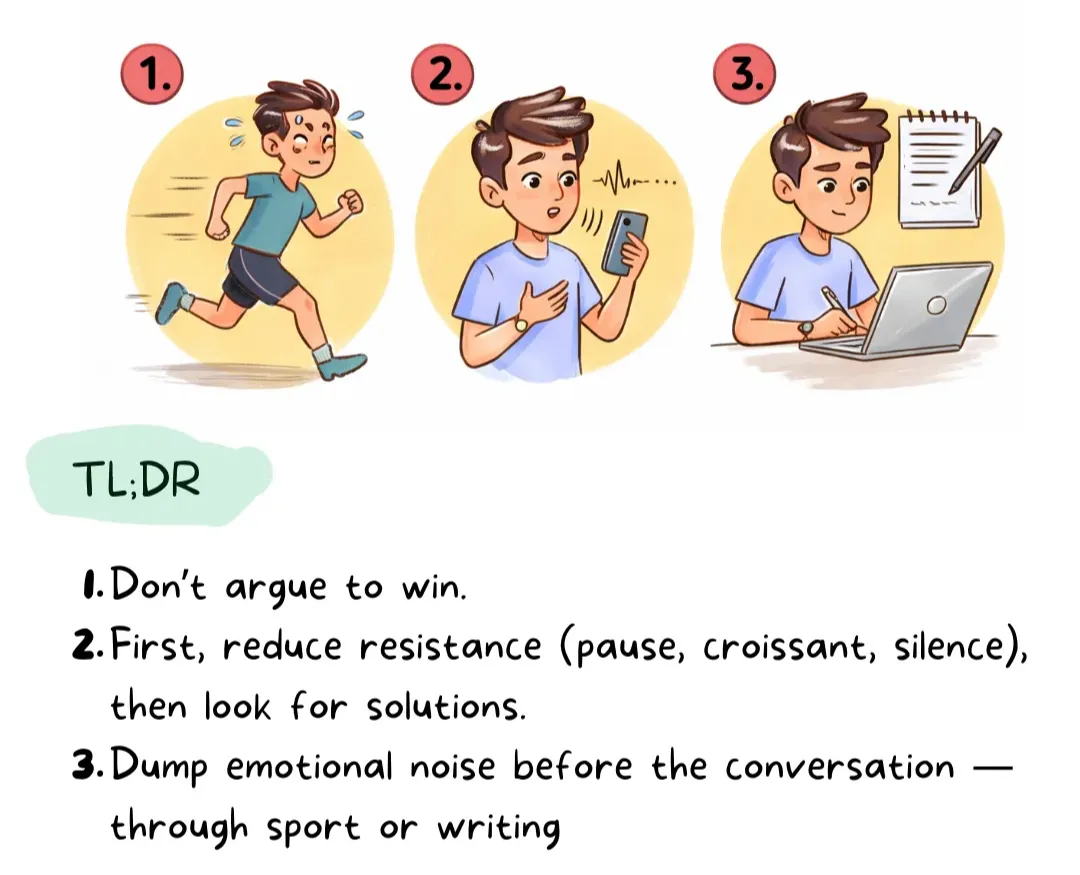
Summing up: in conflict, we often fight not over the topic, but over resistance and the feeling of pressure. First: 1) understand the context — loved ones vs colleagues, 2) reduce resistance (and understand your need), then search for truth. And 3) run + video message + note — a simple way to dump the mess from your head and improve clear thinking, sliding into polemics less often over time.
What kicks in first for you: "prove" or "agree"? What grounding techniques / non-toxic communication training do you use?
running #psychology #management #relationships #emigrantsnotes